
Seville
Inicio » Seville
Here are the itineraries we propose for Seville
The itineraries run either around the historic center or through its interior. Initially, we propose the one around the historic center, and in the near future, we will complement it with itineraries inside the historic center.
Choose your preferred itinerary of 1 hour or 1.5 hours, then select your pick-up and drop-off point.
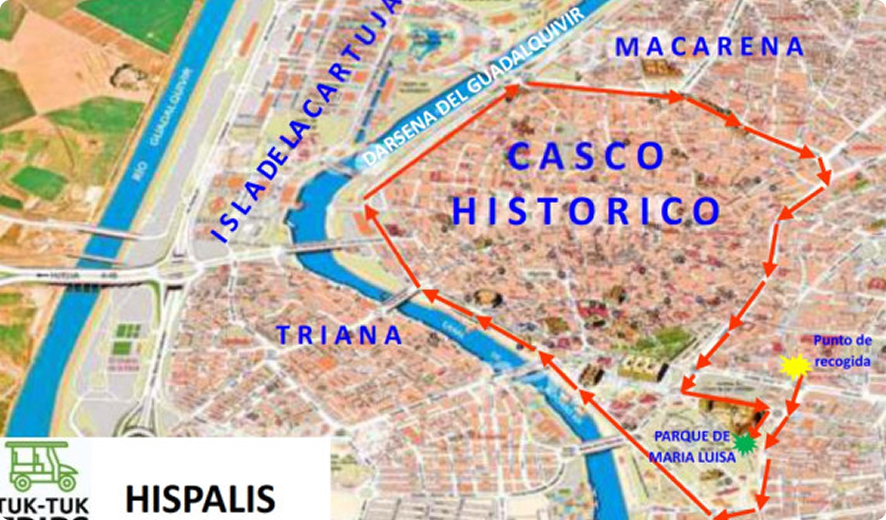
- 55 minutes
- Seville
What’s Included:
- Runs along the perimeter of the historic center.
- View the main buildings and unique landmarks of Seville (Torre del Oro, Triana Bridge, etc.).
- Halfway through the tour, stop for a few minutes to view the Plaza de España.
- Torre del Oro.
- Modern tuk-tuks.
- Official guide
60,00 €
- 85 minutes
- Seville
What’s Included:
- Runs along the perimeter of the historic center.
- View the main buildings and unique landmarks of Seville (Torre del Oro, Triana Bridge, etc.).
- Halfway through the tour, stop for a few minutes to view the Plaza de España.
- Torre del Oro.
- Modern tuk-tuks.
- Official guide
90,00 €
What to do or visit
in Seville

Visiting Seville primarily means visiting its Historic Center, which is one of the largest in Europe, spanning almost 4 square kilometers. It comprises the following neighborhoods: El Arenal, Encarnación-Regina, Alfalfa, San Bartolomé, San Lorenzo, San Gil, Museo, Santa Catalina, Santa Cruz, Feria, San Julián, and San Vicente. Within this area are the main civic, religious, and cultural buildings and monuments, including churches, convents, and unique civil structures.
This Historic Center achieved its first splendor in Roman times, and like almost all Roman cities, Roman Seville or Híspalis was divided into very orderly rectilinear streets. There was a main axis running north to south called the Cardo Maximus, and another axis crossing it from east to west, called the Decumanus Maximus. In the center, a central square corresponded to the forum, and this square was located beneath the current Plaza de la Alfalfa.
Highlighting these historical axes is not trivial, as in our service of showcasing the City of Seville, we aim for it to be understood from its origins: why it has this layout, how the main points of interest are located along these historical axes and in the neighborhoods that converged around the city’s historical zero point, which is currently the Plaza de la Encarnación-Alfalfa, a passing point for many of the itineraries we offer.